
The Factories Are Reopening, Now What?
In the world of fashion product development, how can you make the most of your time during holiday closures?
Summer is winding down, and so is the factory downtime. In only a few days, production floors across Europe start running again, which means now is the time to make sure you have all of your ducks in a row ready to submit to the factory to start the product development process.
If you're new to manufacturing here: factories across Europe close for 2 - 3 weeks starting mid-August for a well-earned break. This happens every year like clockwork, yet it catches new brands off guard.
Then, September hits and everyone's scrambling to get tech packs sorted and factories and fabric options shortlisted, and momentum gets lost before you know it. Or you start emailing factories without a tech pack ready to submit. Weeks of September will vanish and you will still be playing catch up, putting you in the back of the queue of the production line.
Don't be that brand.
Here's what I recommend you have prepared now before the doors reopen.
Tech packs
Fabric preference
Short list of factories - and what type of factory you want to work with?
Let’s dive a little deeper into each of these:
Tech Packs
Don’t overthink this. And don’t underestimate it either.
Tech packs follow a specific, standard order of operations that keeps your designs organised, easy to read, easy to update and easy to track the progression of your collection.
Each style you make requires a tech pack.
Tech packs are a living document that you need to keep updated during the sampling process. In Portugal, we do not start production without tech packs. So do not underestimate the importance of having a clean, communicative document.
AI can help you build a tech pack, however, you have to know what you are doing to spot the errors, because there will be errors! I would not depend on AI yet for a professional tech pack. You can use our templates here if you want to have a factory ready tech pack template that you simply need to copy and personalise. These can be reused time and time again for each collection of every season.
Googlesheets Tech Pack Template - Coming Soon!
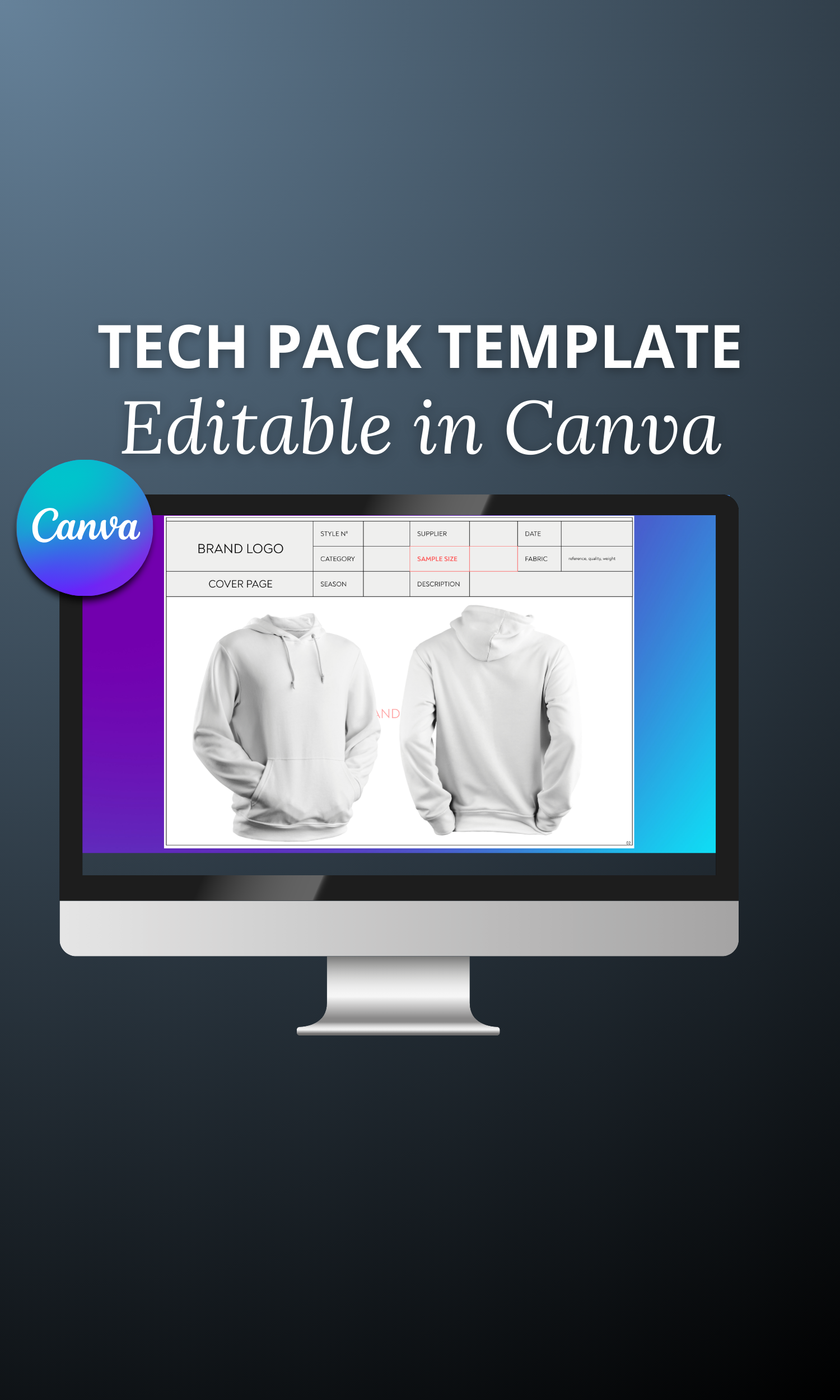
No Adobe Illustrator needed. Duplicate for every style. Edit in minutes, not hours.
Used by fashion founders across 12+ countries to create factory-ready tech packs without expensive software.
You need tech packs for every style, in every collection. If you're serious about building a fashion brand, that's a lot of tech packs over your brand's lifetime.
A tech pack is your product's blueprint. It tells your manufacturer exactly how to bring your design to life with out guessing, endless email chains asking for clarifications, or prototypes that miss the mark.
AND, it helps YOU track what YOU have done with your product, from first draft of the tech pack, to the edits of your first prototype to the decisions made that get you to the finished production. With all of the details necessary that goes into one product, it’s good to start off organised.
Tech Packs Include:
Technical sketches and measurements
Materials, reference codes, and suppliers
Construction notes and seam details
Label and packaging information
Proto fit edits and final approvals
Everything factories need to quote and produce accurately
Without a tech pack, you risk:
Sampling and production delays
Constant back-and-forth for basic details
Unexpected costs from miscommunication
Quality issues and misaligned expectations
Factories dropping you because you're too high-maintenance
Fabric Requirement
On the Bill of Materials (BOM) it is a good idea to have the fabric you prefer listed. If you are working with a vertical factory (more on this below), the factory will source from their supply partners the type of fabric you are looking for.
Get as specific as possible for your fabrics. Cotton for a T-shirt is not enough. It’s a good start, but it’s not enough. Knowing the weight, quality and composition of the fabric that you want is going to help eliminate a lot of back and forth and will streamline the process.
Go for a clear brief:
Jersey
100% cotton
Mid-weight, 200 - 220gsm
If you are using a flat knit manufacturer, instead of fabric, you will need to know yarn gauge and composition (see below).
Factory Type
Vertical
CMT (cut make trim)
Fully Fashioned, Flat knit
Vertical factories have the entire supply chain behind them. You hand in your tech packs, the factory will source materials, from fabric and trims to your labels and hang tags.
Pricing model is everything included: labor, fabric, and trims bundled as a cost per unit.
Downside is your supply chain is not as transparent as if you were handling it all yourself. Within the EU and the upcoming law around DPP (Digital Product Passport), I hope to see this change slightly as transparent supply chains should be mandatory.
CMT, or Cut Make Trim
CMT factories do the cutting and sewing only. Your fabrics, trims, labels, hang tags etc. all must be ordered separately and ready to send to the factory for production.
The pricing model is labor / unit only.
The downside is this model can be a lot for new brands to manage upon first production. You will need to track your costs andof materials used, cost of labor, shipping to achieve your cost per unit.
Flat Knit (Fully Fashion)
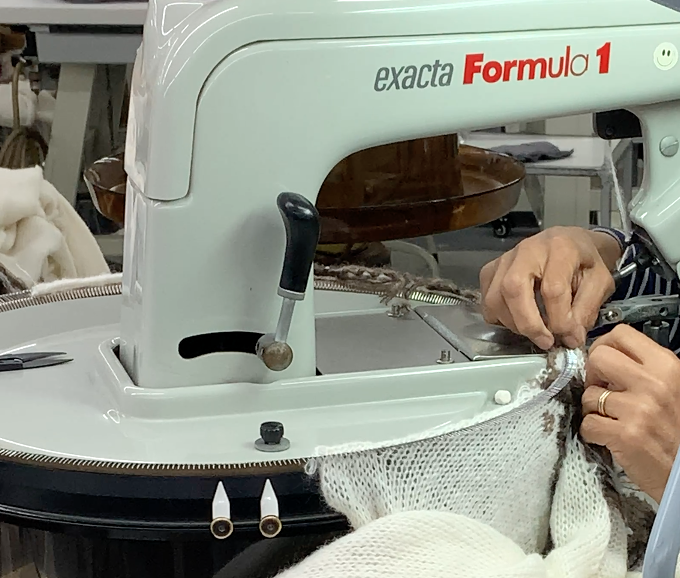
Flat knit machines build a garment piece by piece, knitting each panel to its exact shape. There is no cutting and no fabric waste. Instead of knitting a big roll of fabric and cutting sweater pieces out of it to be sewn together, the machine knits the sweater's front, back, and sleeves as separate finished panels, which are then linked together.
Take a fine-gauge merino cardigan for example. The machine knits the front panel with the button placket, sleeves, and back panel all shaped to size (shoulders sloping in, sleeves tapering), then a linker sews the finished pieces together. No fabric is cut away in the process, which is part of why fully fashioned knitwear tends to sit at a higher price point. There is less waste, more precision, but slower and more specialised production.
These are the details you will need to have organised before you start emailing suppliers to create your collection: tech packs, fabric (or yarn if you are using a flat knit manufacturer), and what type of manufacturing.
Just because your budget is small or you are new to the industry doesn’t mean you don’t have a place here.
Production admin can feel like a lot up front, but don’t let it bog you down.
Keep being creative.


No Adobe Illustrator needed. Duplicate for every style. Edit in minutes, not hours.
Used by fashion founders across 12+ countries to create factory-ready tech packs without expensive software.
You need tech packs for every style, in every collection. If you're serious about building a fashion brand, that's a lot of tech packs over your brand's lifetime.
A tech pack is your product's blueprint. It tells your manufacturer exactly how to bring your design to life with out guessing, endless email chains asking for clarifications, or prototypes that miss the mark.
AND, it helps YOU track what YOU have done with your product, from first draft of the tech pack, to the edits of your first prototype to the decisions made that get you to the finished production. With all of the details necessary that goes into one product, it’s good to start off organised.
Tech Packs Include:
Technical sketches and measurements
Materials, reference codes, and suppliers
Construction notes and seam details
Label and packaging information
Proto fit edits and final approvals
Everything factories need to quote and produce accurately
Without a tech pack, you risk:
Sampling and production delays
Constant back-and-forth for basic details
Unexpected costs from miscommunication
Quality issues and misaligned expectations
Factories dropping you because you're too high-maintenance